Products
The Complete Guide to Selling Custom Caps and Hats
A practical guide to selling custom caps and hats: cap styles, embroidery vs print, sizing and fit, quality signals, design tips, pricing, and launching with print on demand.
Tamm Team7 min read

Custom caps are one of the smartest printed apparel products because they carry a low cost, a wide margin, and complete almost any outfit year-round. To sell them well, start by choosing the style your audience wants (dad cap, snapback, trucker, or beanie), pick a decoration method (embroidery or print), understand sizing and the quality signals that separate a brand cap from a cheap one, price on real costs, and launch with print on demand so you never buy stock before you know what sells. This practical guide takes you from style to launch: a clear styles table, embroidery versus print, quality signals you can feel in the hand, numbered launch steps, and an honest pricing base. The core idea is simple: you can build a full cap brand without tying up a single riyal in inventory that may never move.
Why caps are a smart product to sell
A cap combines advantages that rarely meet in one piece. First, it costs less than a tee or a hoodie yet carries high perceived value, so the margin is comfortable. Second, it is an identity garment people wear daily and keep in plain sight, so it works as a moving billboard for your brand. Third, its flexible sizing makes stock far simpler than apparel, since one adjustable size covers most heads. Add that a cap is bought alongside a tee or hoodie as a set, and it lifts the value of a single basket. The result is a product with a low cost of entry, healthy profit, easy inventory, and clear identity. That combination serves any seller building a streetwear brand.
Cap styles: a quick table
The style sets a cap's personality, its decoration method, and its audience. Choose one style that serves your brand identity instead of mixing all of them in a first drop.
| Style | Description | Sizing and closure | Best for |
|---|---|---|---|
| Dad cap | Curved brim, low soft unstructured front | Adjustable back strap | Simple, quiet daily wear |
| Snapback | Flat brim, six panel, tall structured front | Snap closure, one size | Bold, youthful streetwear |
| Trucker | Foam front with a ventilated mesh back | Snap back, one size | Summer, large logo space |
| Beanie | Knitted, brimless hat | Stretch, one size | Cold weather and highlands |
Start with one style and one drop. An embroidered dad cap with a simple logo is the easiest starting point because it is the cheapest and most widely accepted, then expand into snapbacks and truckers once a design proves it sells.
Embroidery vs print on a cap
The decoration method sets a cap's feel, its cost, and which designs suit it. The thick fabric and curved front demand a different choice than a flat tee.
- Flat embroidery: The most common finish on caps. Durable and premium with a high-end brand feel, it suits logos and lettering, not large graphics or gradients.
- 3D puff embroidery: Letters and marks raised off the surface, common on a snapback's tall front for a bold look.
- DTF heat transfer print: Best for multi-color designs, gradients, and photographic art, and the cheapest way to test many designs in small quantities.
- Embroidered or leather patch: A patch sewn or pressed onto the front, giving a complete brand look and suiting the trucker especially.
For a deeper comparison of fabric print methods, read DTG vs screen printing.
Quality signals you can feel in the hand
A buyer does not read your spec sheet, but they feel quality in an instant. These are the details that separate a brand cap from a cheap one, and every one is felt on arrival.
- Stitch density in the embroidery. Dense, even stitching with no loose threads is a mark of good craft.
- A structured front (buckram). An inner layer that keeps the front standing and the design stable after wear.
- The inner sweatband. A comfortable, cleanly sewn inner band signals higher quality.
- Closure quality. A sturdy plastic snap or a clean metal strap, not cheap plastic that cracks.
- Vents and top button. Clean embroidered eyelets and a fabric-covered top button lift the finished feel.
Cap design tips
The front is small and curved, so a design that works on a tee can fail here. Simplify your logo into a clear shape that reads from a distance, and make the contrast strong between thread color and cap color. For embroidery, prepare a clean vector file with strokes thick enough for the needle, and avoid very fine detail because it disappears in the stitches. For placement, the front is the hero, while the side and back are secondary spaces for a name or a small mark. If you are building a full streetwear label, read how to start a streetwear brand to tie the cap to the rest of your pieces and your story.
Five steps to launch your cap with print on demand
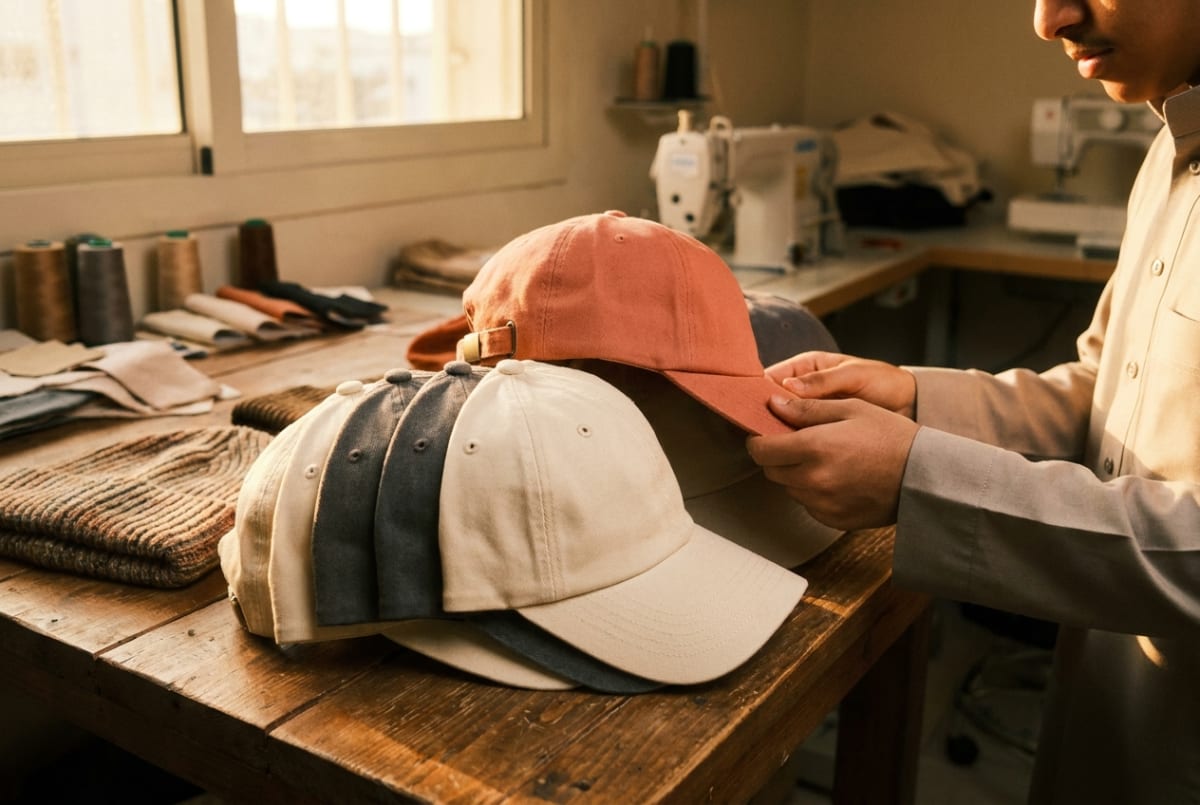
- Choose the style and size. Pick one style from the table above that serves your audience, and start with one adjustable size to keep stock simple.
- Order a sample. Try the cap in your hand before committing to confirm the blank, the closure, and the embroidery quality, because what you see on screen is not what you feel.
- Match the design to the decoration method. A logo and lettering lean toward embroidery, while a multi-color design leans toward print. Design knowing what will be produced.
- Price on real costs. Add the decorated item cost, packaging, shipping, payment fees, and marketing's share, then add a margin.
- Launch with no inventory. Publish the cap for sale, and each piece is decorated after the customer orders and pays, so you test several designs and keep the winner with no loss.
How to price a cap for profit
Price is not a guess. Add every cost that touches the piece: the decorated cap, packaging, shipping, payment gateway fees, and each sale's share of your marketing budget. Then add a margin that lets you grow, not just break even. The advantage of print on demand is that your item cost is known in advance, so you calculate your margin precisely before you sell a thing. Do not price cheap to compete, because a cap is bought for identity and feel, not for the lowest price. And since a cap costs less than a hoodie, its relative margin is often wider, which makes it a smart gateway for building a profitable brand.
Conclusion
Custom caps are a smart product to sell because they have a low cost of entry, healthy profit, easy inventory, and work as a moving billboard for your brand. To sell them well, choose one style that serves your audience, match your design to a decoration method built for a cap, read the quality signals a customer can feel, price on real costs rather than a guess, and launch with print on demand so you test your designs with no inventory and no risk. Start small with one sample and one style, and let the market tell you which design deserves to scale. For the next step, start free with Tamm, and leave the storage and shipping to us while you focus on the brand.
Frequently asked questions
- What is the difference between a dad cap, snapback, trucker, and beanie?
- A dad cap has a curved brim and a soft, low unstructured front with a back strap. A snapback has a flat brim, tall structured front, and a snap closure. A trucker has a foam front and mesh back. A beanie is a knitted, brimless hat for cold weather.
- Embroidery or print on a cap?
- Embroidery is the most common finish on caps because it is durable and premium and suits logos and lettering. DTF heat transfer print is better for multi-color designs and gradients, and it is cheaper for testing many designs in small quantities.
- Is a cap one size fits all?
- Most caps are one size adjustable through a back strap or a snap closure, so they fit most heads. A fitted cap comes in set sizes, and a beanie stretches to fit almost everyone.
- Should I print a batch of caps before I sell?
- No. Start with print on demand, so each piece is embroidered or printed after the customer orders and pays. That way you test your designs with no inventory and no risk before any bulk order.
- How do I price a custom cap?
- Add up the decorated item cost, packaging, shipping, payment gateway fees, and marketing's share, then add a margin that funds growth. With print on demand your item cost is known in advance, so you price precisely.