Print on Demand API: What It Does and How to Choose
Running a custom store or your own system? What a print on demand API does, when a ready-made connection is enough, and what a developer should ask first.
Tamm Team4 min read
Some stores don't live on a ready-made platform: a custom-built shop, an internal order system, an app with its own users. A "connect your store" button does nothing for them. What they need is an interface a developer wires up once, so every order moves without anyone touching it.
This page is for the owner of that system and their developer: what a print on demand API does, whether you need one at all, and the questions worth asking before you choose a provider.
What a print on demand API does
The idea is simple: everything a seller does by hand in a dashboard, your system does in code. Most services revolve around the same parts:
- Catalogue. Your system reads the pieces, their colours, sizes and print areas, rather than you entering them by hand.
- Products and previews. You attach a design to a piece and get product images for your store.
- Pricing. You know an order's cost before you commit to it.
- Orders. Your system sends the order, with its pieces, sizes and the customer's address.
- Updates. The factory tells your system whenever an order's status changes, and sends the tracking number, without you having to keep asking.
When you need an API, and when a ready-made connection is enough
Don't pay a developer for something that already exists. The rule goes like this:
- Your store is on Salla, Zid or Shopify: the ready-made connection is enough, with no code.
- Your store is custom-built, or on another platform: the API is your way in.
- You have an order system or an app: your system sends the order directly, and nobody opens a dashboard.
- You're a platform selling for others: such as one hosting brands or creators, whose printing runs through you.
Five questions your developer should ask before choosing
Every service says it has an API. The difference is in these details:
1. Is there a test environment that prints nothing? Not every provider has one. Without it, your developer tests with real orders, carefully, and hopes.
2. How does your system hear about changes? Look for signed webhooks your system can verify, plus a way to see failed deliveries and send them again.
3. What happens to an order the balance can't cover? Each provider handles it differently: it starts and bills you later, or it waits until you pay. Find out first, because it shapes how your system works.
4. Where does the parcel ship from, and in whose name? Delivery time and customs follow from where the factory is. Ask too what name appears on the parcel.
5. What happens when a piece has a fault? Most companies take fault reports through their dashboard or support, not the API. Know the route before your first report arrives.
How the API works with us
- Your system reads the catalogue, sends us orders, and receives their status and tracking number. We print, pack and ship in your name.
- You start with a test key. You try orders without anything being printed, on the same pieces you'll sell.
- When your system is ready, you apply for the live key. With your business details, and we review and switch it on. We review each one ourselves, because a live key means real orders being printed and shipped.
- The cost comes from your wallet. Like any connected store: the piece and the shipping for each order, with no subscription and no minimum. Each month you get a tax invoice.
- Delivery is inside Saudi Arabia. Usually within two days in every city in the Kingdom, and in rare cases up to 14 days.
The documentation comes with your account: the API's routes, examples and all the technical detail.
What to prepare before you talk to us
- A short description of your system: a store, an app or an internal tool.
- What you want to sell, from the catalogue.
- Who your developer is, and how we reach them.
- Your business details, if you're ready for a live key.
Where Tamm fits
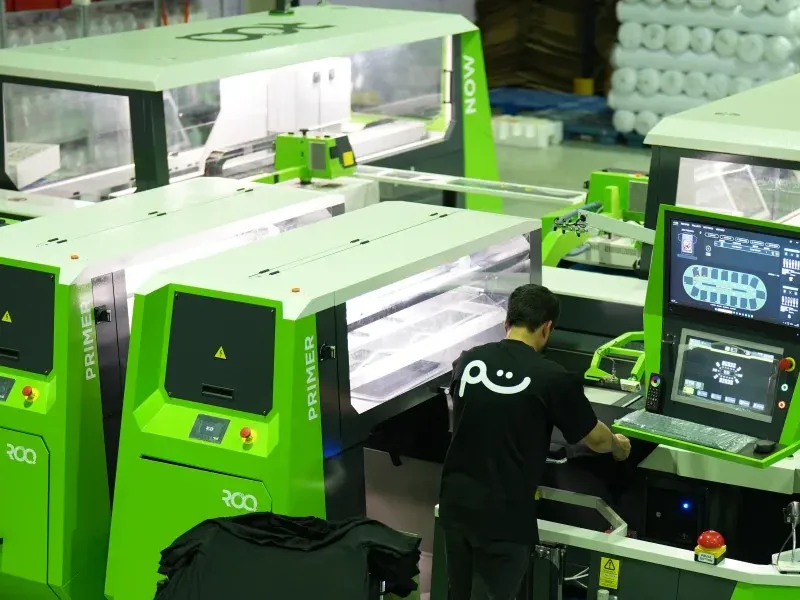
Tamm is a factory and warehouse inside Saudi Arabia, and its API lets your system send the order while we print, pack and ship in your name. Read about connecting through the API
Frequently asked questions
- What is a print on demand API?
- An interface that lets your system talk to the factory directly: it reads the catalogue, sends orders, and receives their status and tracking number, with nobody copying an order by hand.
- When do I need an API instead of a ready-made connection?
- If your store is on Salla, Zid or Shopify, the ready-made connection is enough. The API is for a custom-built store, your own system, or an app that sends orders.
- Can I test before anything is printed?
- Yes. You start with a test key and try orders without anything being printed. When your system is ready, you apply for the live key with your business details, and we review and switch it on.
- Who pays for the orders?
- Your Tamm wallet, like any connected store: the cost of the piece and the shipping for each order.
- Where do you deliver?
- For now inside Saudi Arabia, to every region of the Kingdom, in your name.
- What do I need for a live key?
- Your business details: legal name, commercial registration or freelance licence, VAT number if you're registered, national address, an authorised person, a technical contact, and acceptance of the API terms.